Overview
Rama is the seventh avatar of Vishnu and the central figure of the Ramayana, one of the two great Sanskrit epics. Unlike Krishna, who is openly divine throughout his story, Rama is presented for most of the narrative as a man who does not assert his own divinity — he is maryada purushottama, the supreme person who observes limits.
That restraint is what he is remembered for. He accepts fourteen years of exile to keep his father's word to a stepmother, wages a war to recover his abducted wife, and then, as king, makes a decision about that wife which the tradition itself has argued over for two thousand years. He is held up as the ideal, and the ideal is not made easy.
Rama Rajya — his reign — became the standard Indian metaphor for just government, invoked well outside religious contexts. His story travelled: it exists in Tamil, Bengali, Assamese, Kannada, Telugu, Malayalam, Marathi and Awadhi versions, and in Thai (Ramakien), Khmer, Javanese, Balinese, Lao and Burmese ones, often with different emphases and different endings.
His name is also, in North Indian practice, the commonest word for the divine as such — used in greeting, in grief, and as the mantra carried at funerals.
Origins and history
The Valmiki Ramayana, in Sanskrit, is the earliest surviving version, generally dated between roughly the 5th century BCE and the 1st century CE, with the first and last books (Bala Kanda and Uttara Kanda) usually held to be later additions than the core. The divinity of Rama is much more explicit in those two books than in the middle five, which is one of the main reasons for the dating.
This matters for reading the text. In the older core, Rama is a heroic prince; the framing that identifies him unambiguously with Vishnu belongs to the later layer. The tradition's own view differs, and both readings are worth knowing.
The Adhyatma Ramayana (c. 14th–15th century), embedded in the Brahmanda Purana, recasts the story in explicitly Advaitic and devotional terms and is the direct source for what came next.
Tulsidas's Ramcharitmanas (1574 CE), in Awadhi rather than Sanskrit, is the version most North Indians actually know. Its influence is hard to overstate: it moved the story out of Sanskrit scholarship into household recitation, and the Ramlila performances staged across North India each autumn are largely built on it. UNESCO inscribed Ramlila on its Intangible Cultural Heritage list in 2008.
Kamban's Ramavataram (c. 12th century) is the great Tamil telling, and is a substantially independent literary work rather than a translation. Krittibas Ojha's Bengali version (15th century) is the source of several episodes — including Durga's akal bodhan — that are widely but wrongly attributed to Valmiki.
Iconography and symbolism
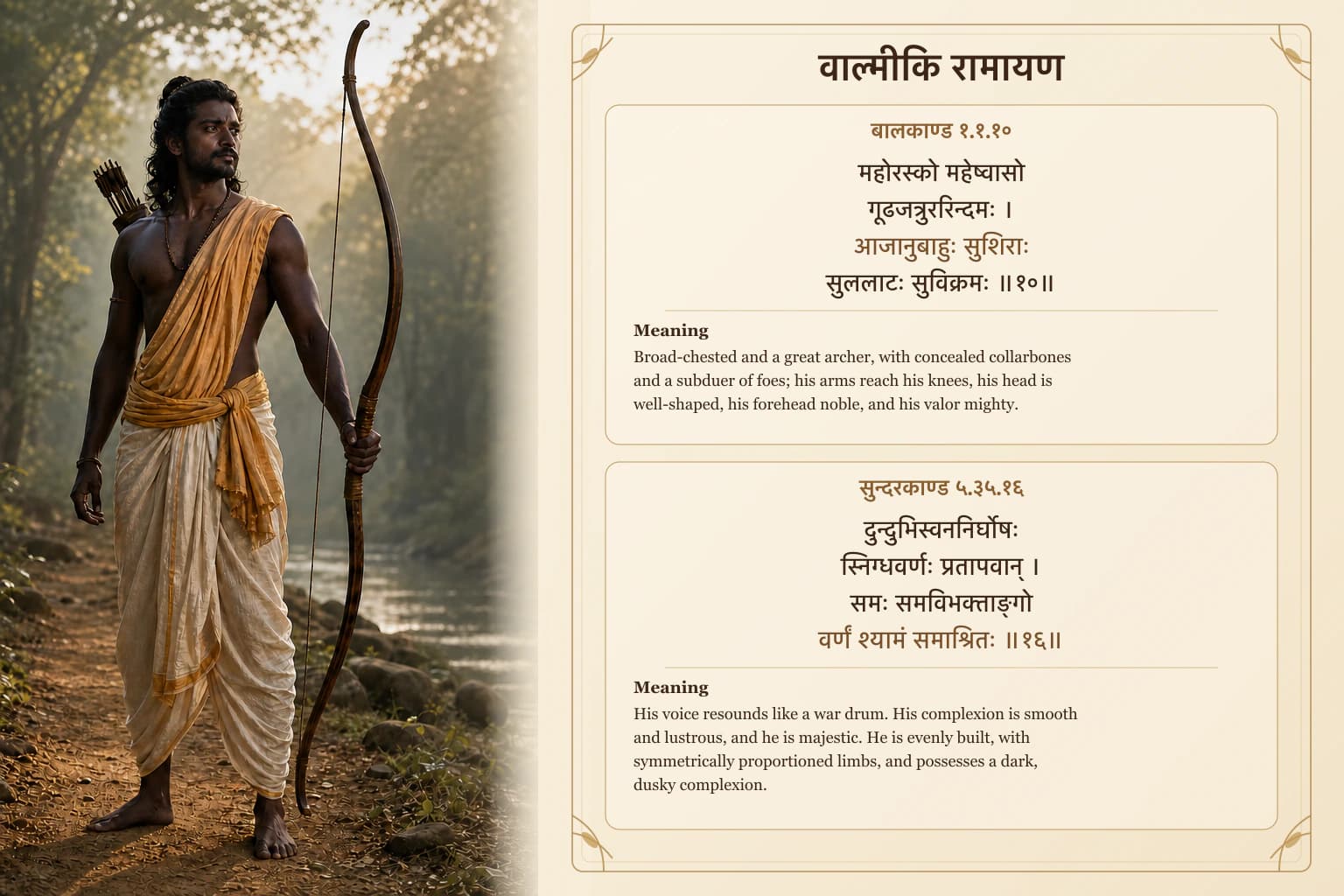
Rama is shown as a standing figure holding a bow, dark-skinned like Vishnu, crowned, and almost always in company rather than alone.
The standard group — the Ram Darbar — places Sita at his right, his brother Lakshmana with a bow behind, and Hanuman kneeling or seated at his feet with hands joined. The arrangement is itself the teaching: the ideal king is shown with the wife, the brother and the devotee rather than in solitary majesty.
His bow is the Kodanda, and Kodandarama is a common temple dedication. Where Krishna's attribute is a flute and Shiva's a trident, Rama's is a weapon he is reluctant to use — the epic makes a point of his restraint.
He wears no ornament in the exile portions of the story, and images of the forest years show him in bark garments with matted hair, closer to an ascetic than a prince.
Forms and aspects
Rama is not worshipped through a wide range of forms in the way Shiva or Devi are — his identity is tied to a single narrative. The variations are mainly of moment and of company.
Kodandarama — the archer, bow in hand.
Ram Darbar — the court, with Sita, Lakshmana and Hanuman, the commonest household image.
Rama Pattabhisheka — the coronation, the scene that closes the story's main arc and the emblem of Rama Rajya.
Vanavasa Rama — the forest years, in bark cloth.
His brothers Bharata, Lakshmana and Shatrughna are understood as partial descents alongside him, and Lakshmana is frequently identified with the serpent Shesha, on whom Vishnu reclines.
Legends and stories
The bow of Shiva. At Mithila, Rama strings and breaks the bow no one else can lift, and wins Sita.
The exile. On the eve of his coronation, Kaikeyi calls in two old boons: Bharata to be king, Rama to the forest for fourteen years. Rama goes without argument, and Sita and Lakshmana follow. Bharata refuses the throne and rules with Rama's sandals placed on it.
The abduction. Ravana, king of Lanka, takes Sita by deception after the demoness Shurpanakha is humiliated and a golden deer draws Rama away.
The search and the alliance. Rama allies with the vanara king Sugriva. Hanuman crosses the ocean, finds Sita in the Ashoka grove, and brings back her token.
The bridge and the war. The vanaras build a causeway to Lanka. Ravana is killed on the tenth day — Vijayadashami. The return to Ayodhya is marked with lamps, which is one of the accounts given for Diwali.
The Uttara Kanda. After the coronation, gossip in Ayodhya about Sita's time in Ravana's captivity leads Rama to send her, pregnant, to the forest. She raises Lava and Kusha at Valmiki's hermitage; when Rama finally calls her back and asks for a further public proof, she calls on the earth to take her, and it does. The tradition has never been comfortable with this, and has not resolved it — many commentators regard the whole book as a later addition, and Tulsidas handles it very differently from Valmiki.
Worship and observance
Rama Navami, the ninth day of the waxing moon in Chaitra (March–April), marks his birth at noon: fasting, recitation, and the reading of the Ramayana.
Ramlila, in the nine nights before Dussehra, stages the story across North India, ending with the burning of Ravana's effigy on Vijayadashami. Diwali, twenty days later, is kept in the north as the celebration of his return.
The Akhanda Ramayana — an unbroken recitation of the Ramcharitmanas over roughly twenty-four hours — is a common household and community observance. Ram katha, narrated exposition over several days, draws very large audiences.
His mantras are unusually simple, which is deliberate: श्री राम जय राम जय जय राम is the Marathi-Konkani tarak mantra, and the two-syllable राम alone is the taraka name held to carry the whole. राम नाम सत्य है is chanted at funerals across North India.
Tulsi is offered. Hanuman is worshipped alongside him almost universally — a Rama temple without a Hanuman shrine is rare.
Major temples
Ram Mandir, Ayodhya — at the site the tradition identifies as his birthplace. The present temple was consecrated in January 2024, after a dispute over the site that ran through the Indian courts for decades and was decided by the Supreme Court in 2019.
Ramaswamy Temple, Kumbakonam, Tamil Nadu — unusual in being dedicated to Rama rather than to Vishnu in another form, and known for its narrative sculpture.
Bhadrachalam, Telangana — on the Godavari, associated with the 17th-century devotee-composer Bhakta Ramadasu.
Rameswaram, Tamil Nadu — a Jyotirlinga, where the tradition holds Rama worshipped Shiva before or after the war; one of the Char Dham.
Triprayar Sri Rama, Kerala and Kalaram Mandir, Nashik, the latter near Panchavati, where the epic places much of the forest exile.
Chitrakoot, on the Madhya Pradesh–Uttar Pradesh border, and Hampi in Karnataka, identified with Kishkindha, are pilgrimage geographies rather than single temples.
Philosophical significance
Rama's title is maryada purushottama — the supreme person who keeps within limits. The word maryada means boundary or propriety, and it names precisely what the character is for: he is the deity who binds himself by rules rather than the one who transcends them. Krishna breaks conventions and the tradition celebrates it; Rama keeps them, at severe personal cost, and the tradition celebrates that instead. Holding both up as ideals is not an inconsistency the tradition has failed to notice.
Rama Rajya became the standard Indian image of good government — a reign under which no one suffers want or injustice — and was invoked as a political ideal well into the twentieth century, notably by Gandhi, who meant by it something closer to a moral order than a theocracy.
The Uttara Kanda is where the ideal turns difficult, and it should not be smoothed over. A king who is right about everything except his own wife, and who chooses public opinion over her, is a hard figure to defend, and the tradition's long argument about that book is part of its seriousness rather than an embarrassment.
The relationship with Hanuman is the other great legacy. It gave Hindu devotion its clearest model of dasya bhava — service as a mode of love — and made Rama, for millions, less a distant ideal than the object of an intensely personal attachment.
Family and forms
Avatar of
Consorts
- Sita: Married at Mithila after Rama strings the bow of Shiva (Bala Kanda 66-73). Sita's own record carries the identification with Lakshmi.
Attendants
- Hanuman: The tradition treats Hanuman as devotee rather than servant; the relationship is the model for bhakti itself.
Part of
- Dashavatara: Seventh. Maryada Purushottama, the descent that becomes a model for conduct rather than a rescue.