Loading…
Hindu Gods and Goddessesदेवी-देवता
Where each deity comes from, how they are depicted and why, the forms they take, the stories that define them, and how they are worshipped — written to be read rather than recited, and honest about where the traditions disagree.
Try a name, an epithet, or a tradition — Bholenath, Vinayaka, Shakta.
Principal deities
Shiva
शिवThe Auspicious One
One of the principal deities of Hinduism: the ascetic on Kailasa and the householder with Parvati, the destroyer within the Trimurti and, for Shaivas, the supreme reality itself. Worshipped chiefly in the aniconic form of the linga, and across India at the twelve Jyotirlingas.
Shaiva
Vishnu
विष्णुThe Preserver
The preserver of the Trimurti and, for Vaishnavas, the supreme reality — the deity who descends into the world as an avatar whenever dharma falters. Worshipped directly and through his descents, of whom Rama and Krishna are the most beloved.
Vaishnava
Krishna
कृष्णThe All-Attractive One
The eighth avatar of Vishnu and, for many traditions, the complete descent rather than a partial one — the cowherd of Vrindavan, the statesman of Dwarka, and the charioteer who speaks the Bhagavad Gita.
VaishnavaAvatar
 AI art
Rama
रामThe Ideal King
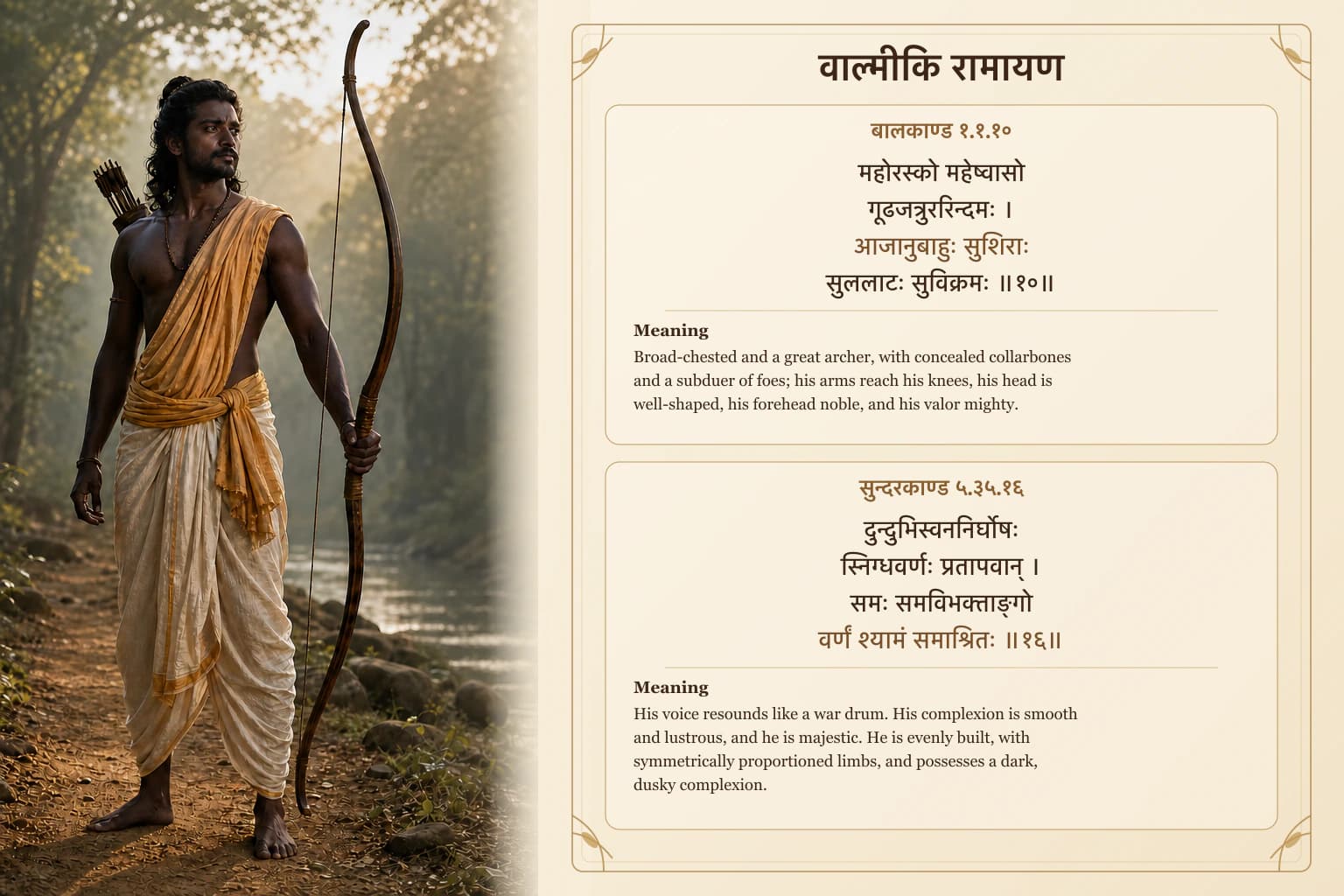
The seventh avatar of Vishnu and the hero of the Ramayana — the prince of Ayodhya whose exile, search for Sita and war with Ravana became the template for kingship, duty and devotion across South and Southeast Asia.
VaishnavaAvatar
Ganesha
गणेशThe Remover of Obstacles
The elephant-headed son of Shiva and Parvati, invoked before every undertaking. Ganesha is worshipped across sectarian lines — Shaiva, Vaishnava, Shakta and Smarta households alike begin with him — which makes him one of the most widely venerated deities in the Hindu world.
Smarta
Hanuman
हनुमानThe Devoted One
The vanara who crossed the ocean to find Sita, and the tradition's model of devotion as service. Among the most widely worshipped deities in India — invoked for courage, protection and steadiness, honoured on Tuesdays and Saturdays, and praised in the Hanuman Chalisa, very likely the most recited devotional text in the world.
Vaishnava
Devi
देवीThe Great Goddess
The Goddess as the supreme reality — Mahadevi, of whom Durga, Kali, Lakshmi, Saraswati and Parvati are aspects. The centre of Shaktism, one of the major traditions of Hinduism, and the subject of the Devi Mahatmya.
Shakta
Durga
दुर्गाThe Invincible
The warrior goddess who destroys Mahishasura — worshipped across India during Navaratri and, in Bengal and the east, at Durga Puja. In Shakta theology she is not an assistant to the gods but the supreme reality from whom they draw their power.
ShaktaForm / aspect
Kali
कालीShe Who Is Time
The fierce form of the Goddess — black, garlanded with skulls, standing on Shiva. Central to Bengali and tantric Shaktism, and understood not as a goddess of destruction but of time, which destroys everything and is not therefore evil.
ShaktaForm / aspect
Lakshmi
लक्ष्मीGoddess of Fortune
The goddess of fortune, abundance and wellbeing, and the consort of Vishnu. Worshipped at Diwali in nearly every Hindu household, and understood in Sri Vaishnavism not as an attendant of the supreme but as inseparable from it.
Vaishnava
Saraswati
सरस्वतीGoddess of Knowledge
Goddess of knowledge, music, speech and the arts — and, in the Rigveda, a river. Worshipped at Vasant Panchami by students and musicians, and the deity before whom children are traditionally taught to write their first letters.
Smarta
Sita
सीताThe Daughter of the Furrow
The wife of Rama and the heart of the Ramayana — found in a ploughed furrow, married at Mithila, carried off to Lanka, and in the end returned to the earth she came from. Worshipped as Lakshmi's descent and as a goddess of the earth in her own right.
VaishnavaAvatar
Surya
सूर्यThe Sun
The sun as a deity — the one major Hindu god who is directly visible. Invoked in the Gayatri mantra, worshipped at Chhath and Makar Sankranti, and once the centre of a distinct sect with its own great temples at Konark and Modhera.
Smarta
Murugan
मुरुगनThe Tamil God
Kartikeya in the north and Murugan in the Tamil country — the youthful commander of the divine armies, worshipped at the six Arupadai Veedu shrines and at Thaipusam, and one of the most fervently followed deities in South India and the Tamil diaspora.
Shaiva
Kamakhya
कामाख्याShe Who Is Called Desire
The goddess of Nilachal Hill in Assam, worshipped as a cleft in the rock kept wet by a spring — no image, no face. The most important seat of tantric Shaktism in India, and the one great shrine where a goddess's menstruation is the central sacred event of the year.
ShaktaForm / aspect
Jagannath
जगन्नाथLord of the Universe
The deity of Puri, worshipped in a wooden form unlike any other Hindu image, alongside his brother Balabhadra and sister Subhadra. Identified with Krishna, and the origin of the Rath Yatra — and of the English word 'juggernaut'.
VaishnavaForm / aspect
Venkateswara
वेंकटेश्वरLord of the Seven Hills
The form of Vishnu worshipped at Tirumala — among the most visited religious sites on earth, and the wealthiest temple in India. Known as Balaji, Srinivasa and Govinda, and approached with the distinctive vows of tonsure and hair offering.
VaishnavaForm / aspect
Ganga
गंगाThe River Goddess
The Ganges as a goddess — a river worshipped as a living deity along its whole course, held to purify what is immersed in it, and central to Hindu death rites. Also one of the most polluted major rivers in the world, which is a fact the tradition now has to hold alongside the other.
Smarta
Radha
राधाThe Beloved of Krishna
Krishna's beloved, and in several traditions the personification of devotion itself. A relatively late arrival in the textual record who became, within a few centuries, inseparable from him — her name spoken first in the greeting Radhe Krishna.
Vaishnava
Kaal Bhairav
काल भैरवThe Lord of Time
Shiva as the fierce guardian of time and of boundaries — the koṭwāl of Kashi, who carries the staff of consequence and a dog at his feet. In the Kashmir Shaiva tantras he is not an aspect of the Absolute but the Absolute itself.
ShaivaForm / aspect
Dasha Mahavidya
दस महाविद्याThe Ten Wisdom Goddesses
The ten wisdom goddesses of the Shakta Tantras — Kali, Tara, Tripura Sundari, Bhuvaneshvari, Bhairavi, Chhinnamasta, Dhumavati, Bagalamukhi, Matangi and Kamalatmika. Not ten deities but one Shakti counted ten ways, deliberately spanning a sixteen-year-old beauty, an old widow and a goddess who has cut off her own head.
ShaktaGroup
Tripura Sundari
त्रिपुर सुन्दरीThe Beauty of the Three Worlds
Third of the Mahavidyas and supreme goddess of the Srikula — known as Lalita, Shodashi and Rajarajeshvari. Approached less through an image than through the Sri Chakra and the Srividya mantra, hers is the most philosophically elaborated system in Shaktism.
ShaktaForm / aspect
Dashavatara
दशावतारThe Ten Descents of Vishnu
The ten principal avatars of Vishnu — fish, tortoise, boar, man-lion, dwarf, axe-bearer, Rama, Krishna, the ninth over which the lists disagree, and Kalki who has not yet come. A set that is later, more contested and more interesting than the popular version of it suggests.
VaishnavaGroup
Navagraha
नवग्रहThe Nine Grasping Ones
The nine grahas — Sun, Moon, Mars, Mercury, Jupiter, Venus, Saturn, and the two shadow-nodes Rahu and Ketu — worshipped together in a shrine where no two of them face each other. Not planets, and not gods of fate: the tradition calls them dispensers of one's own past action.
SmartaGroup
Nataraja
नटराजLord of the Dance
Shiva dancing the Ananda Tandava inside a ring of fire, one foot on the dwarf of heedlessness and one raised. A Chola bronze that became the most widely reproduced image in Indian art, and a compressed statement of the five acts by which the world is made, held, ended, hidden and released.
ShaivaForm / aspect
Meenakshi
मीनाक्षीThe Fish-Eyed Queen of Madurai
Born from fire with three breasts, raised as a warrior, crowned as the Pandya sovereign, and married to Shiva only after she had conquered the eight directions. The goddess whose name the temple carries and who is worshipped there before her husband.
ShaktaForm / aspect
Vithoba
विठोबाHe Who Waits on the Brick
Krishna standing on a brick at Pandharpur with his hands on his hips, waiting — because a devotee asked him to wait while he finished serving his parents. The deity of the Varkari movement, of the Wari pilgrimage, and of some of the finest devotional poetry in any Indian language.
VaishnavaForm / aspect
Vaishno Devi
वैष्णो देवीThe Three Pindis of Trikuta
Three natural rock formations in a cave on a Jammu hillside, worshipped as Mahakali, Mahalakshmi and Mahasaraswati in one. India's most-walked pilgrimage after the Kumbh, with no image, no priest-mediated sanctum figure, and a goddess whose story turns on a refusal.
ShaktaForm / aspect
Adityas
आदित्यThe Sons of Aditi, Sovereigns of the Rita
The sovereign gods of the Rigveda — Varuna, Mitra, Aryaman, Bhaga and their brothers — sons of the boundless Aditi, who watch without blinking and bind the man who breaks his word. Six or seven in the Veda, twelve by the Puranas, one for each month of the sun's year.
VedicGroup
Soma Pavamana
सोम पवमानThe God You Could Drink
A plant, its pressed juice, and a god — one thing, addressed by the whole of the Rigveda's ninth book. Nobody now knows what the plant was, the ritual that needed it is still performed with substitutes, and the name ended up on the moon.
Vedic
Ushas
उषस्Daughter of the Sky
The dawn: twenty-one hymns, the finest poetry in the Rigveda, and a goddess who wakes every living thing and wastes a little of everyone's life doing it. Cognate with Eos, Aurora and Easter — and almost completely forgotten in India.
Vedic
Purusha
पुरुषThe Cosmic Person
A thousand-headed being sacrificed by the gods, from whose body the worlds, the Vedas, the animals and the four varnas are made. Sixteen verses, recited daily in Vaishnava temples — and the single most consequential passage in Indian social history.
Vedic
Trimurti
त्रिमूर्तिThe Three Forms
Brahma, Vishnu and Shiva as creator, preserver and destroyer — the scheme every introduction to Hinduism opens with, and the one almost no Hindu actually worships. A harmonising device rather than a lived theology, and the evidence is that one of the three has a single temple.
SmartaGroup
Navadurga
नवदुर्गाThe Nine Nights, One Each
Nine forms of Durga, one for each night of Navaratri — Shailaputri to Siddhidatri. A list of nine names in a protective hymn that became the structure of the largest goddess festival in the world.
ShaktaGroup
Mohini
मोहिनीThe Only Female Avatar
Vishnu as a woman — the single female descent in the whole avatar scheme. She distributes the nectar so the gods get it, makes a demon burn himself, and overcomes Shiva, and every one of those is accomplished without a weapon.
VaishnavaAvatar
Sati
सतीDaksha's Daughter, Who Would Not Be Insulted
Shiva's first wife, who gave up her body at her father's sacrifice because he had insulted her husband — and whose scattered body became the fifty-one Shakti Peethas. She died before Shiva, not after him, which is the fact the practice named for her obscures.
ShaktaForm / aspect
Mahabali
महाबलिThe King Who Is Allowed Back Once a Year
The asura king whose reign Kerala remembers as the time when everyone was equal and nobody lied — dispossessed by Vishnu in three steps, and granted one visit a year. Onam is his homecoming, and Maharashtra wishes openly for his kingdom to return.
Vaishnava
Goddesses
Devi
देवीThe Great Goddess
The Goddess as the supreme reality — Mahadevi, of whom Durga, Kali, Lakshmi, Saraswati and Parvati are aspects. The centre of Shaktism, one of the major traditions of Hinduism, and the subject of the Devi Mahatmya.
Shakta
Durga
दुर्गाThe Invincible
The warrior goddess who destroys Mahishasura — worshipped across India during Navaratri and, in Bengal and the east, at Durga Puja. In Shakta theology she is not an assistant to the gods but the supreme reality from whom they draw their power.
ShaktaForm / aspect
Kali
कालीShe Who Is Time
The fierce form of the Goddess — black, garlanded with skulls, standing on Shiva. Central to Bengali and tantric Shaktism, and understood not as a goddess of destruction but of time, which destroys everything and is not therefore evil.
ShaktaForm / aspect
Lakshmi
लक्ष्मीGoddess of Fortune
The goddess of fortune, abundance and wellbeing, and the consort of Vishnu. Worshipped at Diwali in nearly every Hindu household, and understood in Sri Vaishnavism not as an attendant of the supreme but as inseparable from it.
Vaishnava
Saraswati
सरस्वतीGoddess of Knowledge
Goddess of knowledge, music, speech and the arts — and, in the Rigveda, a river. Worshipped at Vasant Panchami by students and musicians, and the deity before whom children are traditionally taught to write their first letters.
Smarta
Sita
सीताThe Daughter of the Furrow
The wife of Rama and the heart of the Ramayana — found in a ploughed furrow, married at Mithila, carried off to Lanka, and in the end returned to the earth she came from. Worshipped as Lakshmi's descent and as a goddess of the earth in her own right.
VaishnavaAvatar
Kamakhya
कामाख्याShe Who Is Called Desire
The goddess of Nilachal Hill in Assam, worshipped as a cleft in the rock kept wet by a spring — no image, no face. The most important seat of tantric Shaktism in India, and the one great shrine where a goddess's menstruation is the central sacred event of the year.
ShaktaForm / aspect
Ganga
गंगाThe River Goddess
The Ganges as a goddess — a river worshipped as a living deity along its whole course, held to purify what is immersed in it, and central to Hindu death rites. Also one of the most polluted major rivers in the world, which is a fact the tradition now has to hold alongside the other.
Smarta
Radha
राधाThe Beloved of Krishna
Krishna's beloved, and in several traditions the personification of devotion itself. A relatively late arrival in the textual record who became, within a few centuries, inseparable from him — her name spoken first in the greeting Radhe Krishna.
Vaishnava
Dasha Mahavidya
दस महाविद्याThe Ten Wisdom Goddesses
The ten wisdom goddesses of the Shakta Tantras — Kali, Tara, Tripura Sundari, Bhuvaneshvari, Bhairavi, Chhinnamasta, Dhumavati, Bagalamukhi, Matangi and Kamalatmika. Not ten deities but one Shakti counted ten ways, deliberately spanning a sixteen-year-old beauty, an old widow and a goddess who has cut off her own head.
ShaktaGroup
Tripura Sundari
त्रिपुर सुन्दरीThe Beauty of the Three Worlds
Third of the Mahavidyas and supreme goddess of the Srikula — known as Lalita, Shodashi and Rajarajeshvari. Approached less through an image than through the Sri Chakra and the Srividya mantra, hers is the most philosophically elaborated system in Shaktism.
ShaktaForm / aspect
Meenakshi
मीनाक्षीThe Fish-Eyed Queen of Madurai
Born from fire with three breasts, raised as a warrior, crowned as the Pandya sovereign, and married to Shiva only after she had conquered the eight directions. The goddess whose name the temple carries and who is worshipped there before her husband.
ShaktaForm / aspect
Vaishno Devi
वैष्णो देवीThe Three Pindis of Trikuta
Three natural rock formations in a cave on a Jammu hillside, worshipped as Mahakali, Mahalakshmi and Mahasaraswati in one. India's most-walked pilgrimage after the Kumbh, with no image, no priest-mediated sanctum figure, and a goddess whose story turns on a refusal.
ShaktaForm / aspect
Ushas
उषस्Daughter of the Sky
The dawn: twenty-one hymns, the finest poetry in the Rigveda, and a goddess who wakes every living thing and wastes a little of everyone's life doing it. Cognate with Eos, Aurora and Easter — and almost completely forgotten in India.
Vedic
Navadurga
नवदुर्गाThe Nine Nights, One Each
Nine forms of Durga, one for each night of Navaratri — Shailaputri to Siddhidatri. A list of nine names in a protective hymn that became the structure of the largest goddess festival in the world.
ShaktaGroup
Mohini
मोहिनीThe Only Female Avatar
Vishnu as a woman — the single female descent in the whole avatar scheme. She distributes the nectar so the gods get it, makes a demon burn himself, and overcomes Shiva, and every one of those is accomplished without a weapon.
VaishnavaAvatar
Sati
सतीDaksha's Daughter, Who Would Not Be Insulted
Shiva's first wife, who gave up her body at her father's sacrifice because he had insulted her husband — and whose scattered body became the fifty-one Shakti Peethas. She died before Shiva, not after him, which is the fact the practice named for her obscures.
ShaktaForm / aspect
Parvati
पार्वतीDaughter of the Mountain
Shiva's consort and the benign form of the Goddess — daughter of the Himalaya, mother of Ganesha and Kartikeya, and the figure through whom the ascetic Shiva is drawn back into the world.
ShaivaForm / aspect
Yamuna
यमुनाSister of Death
The Yamuna as a goddess — daughter of the sun, twin sister of Yama, and the river of Krishna's Braj. Second only to the Ganga in sanctity, and among the most polluted rivers in the world.
Smarta
Tara
ताराShe Who Carries Across
The second Mahavidya, and the one goddess that Hindu and Buddhist Asia visibly share. Blue-black, standing on a corpse, with a Buddha seated in her hair — and in her defining Hindu story, nursing Shiva after he swallows the poison that would have ended the world.
ShaktaForm / aspect
Bhuvaneshvari
भुवनेश्वरीMistress of the Worlds
The fourth Mahavidya, and the one who is space itself — the room in which everything else happens. Her seed syllable hrīṃ is treated in the Tantras as the feminine counterpart of om, and the Devi Gita is spoken in her voice.
ShaktaForm / aspect
Bhairavi
भैरवीShe Who Ripens and Consumes
Fifth of the Mahavidyas — red, blood-smeared, garlanded with severed heads, and holding a book and a rosary. She governs the process by which things ripen toward their end, and the heat of the practice that ripens a practitioner.
ShaktaForm / aspect
Chhinnamasta
छिन्नमस्ताShe Whose Head Is Severed
The sixth Mahavidya, and the most startling image in Hindu iconography: a goddess who has cut off her own head, drinks the blood from her own neck, and stands on a copulating couple. Every element of it is an argument about where energy comes from and where it goes.
ShaktaForm / aspect
Dhumavati
धूमावतीThe Goddess of Smoke
The seventh Mahavidya: old, alone, hungry, dressed as a widow, riding a crow on a chariot with no horses. She is everything Hindu practice normally treats as inauspicious, gathered into one figure and worshipped anyway.
ShaktaForm / aspect
Bagalamukhi
बगलामुखीShe Who Stills
The eighth Mahavidya, yellow from head to foot, seated on a golden throne with a club raised in one hand and an opponent's tongue held in the other. Her domain is stillness — the arresting of motion, of speech, and of the impulse to act.
ShaktaForm / aspect
Matangi
मातंगीThe Outcaste Goddess of Speech
The ninth Mahavidya: dark green, playing a veena with a parrot on her hand, and worshipped with ucchishta — food already eaten from, which every other Hindu ritual treats as unofferable. She is the goddess of speech, music and everything the purity order excludes.
ShaktaForm / aspect
Kamalatmika
कमलात्मिकाShe Whose Self Is the Lotus
The tenth and last Mahavidya — golden, seated on a lotus, bathed by four elephants. She is Lakshmi, placed at the end of a sequence that runs through cremation grounds, severed heads and widowhood, and arrives at abundance.
ShaktaForm / aspect
Annapurna
अन्नपूर्णाShe Who Is Full of Food
Parvati as the goddess who feeds — with a ladle in one hand and a bowl of rice in the other, and Shiva standing before her holding out a begging bowl. Kashi's own goddess, and the deity behind the temple kitchen, the langar and the Annakut.
ShaktaForm / aspect
Chamunda
चामुण्डाSlayer of Chanda and Munda
The goddess who received her name by bringing two demons' heads to Durga. Emaciated to the bone, garlanded with skulls, seated on a corpse — and, on a hill above Mysuru, the serene tutelary of a dynasty. The same name covers both, and the distance between them is the point.
ShaktaForm / aspect
Gayatri
गायत्रीMother of the Vedas
The goddess of the verse recited at dawn, noon and dusk by more people than any other in Hinduism. Five-faced, swan-borne, called Vedamata — and the subject of a long, uncomfortable and now largely resolved argument about who was permitted to say her mantra.
Vedic
Shitala
शीतलाThe Cool One
The goddess of smallpox, worshipped on a donkey with a winnowing fan and a pot of cold water. Her disease was eradicated by vaccination in the 1970s; her cult was not. One of the clearest windows in Hinduism onto how a village goddess actually works.
Shakta
Tulsi
तुलसीThe Goddess Who Is a Plant
Holy basil, growing in a raised planter in the courtyard, watered every morning and given a lamp every dusk — and married to Vishnu once a year in a full wedding with guests, music and a canopy. The most-worshipped goddess in India by number of households, and the one with no temple.
Vaishnava
Aditi
अदितिThe Unbound
A goddess whose name means boundlessness, who has not a single hymn addressed to her alone, and of whom the Rigveda says: Aditi is the sky, the air, the mother, the father and the son; Aditi is all the gods and everything that has been born and is yet to be born.
Vedic
Prithvi
पृथ्वीThe Broad One
The earth: one Rigvedic hymn to herself, six shared with the sky, and the sixty-three verses of the Atharvaveda's Bhumi Sukta — the finest hymn to the earth in Indian literature, whose line "the earth is my mother and I am the son of the earth" is quoted wherever Indians argue about the environment.
Vedic
Vac
वाच्Speech, Who Speaks for Herself
One hymn, eight verses, spoken in the first person by a goddess who says she carries Mitra and Varuna, makes whom she loves into a sage, and pervades heaven and earth. The oldest text the Shakta tradition claims, and it is recited at every Durga Saptashati.
Vedic
Apas
आपःThe Waters, Who Are Mothers
Four Rigvedic hymns to the Waters, always feminine and always plural. Of every deity in this encyclopedia, they are the one whose worship never stopped: their verse is said at every Hindu bath, sipping and consecration, and has been for three thousand years.
Vedic
Ratri
रात्रिNight, Who Is Asked to Be Easy to Cross
Eight verses to the Night, who comes looking about with many eyes, sends the birds to their nests and the cattle to their stalls, and is asked to keep off the wolf and be easy to get across. One of the few Vedic goddesses who made it into living Shakta liturgy.
Vedic
Aranyani
अरण्यानीThe Forest, Who Does Not Ask After the Village
Six verses to the goddess of the wilderness — the only hymn of its kind in the Rigveda, and the finest nature writing in it. She has no cult, no temple and no descendants; what she named survives in the sacred groves.
Vedic
Nirrti
निऋतिUn-Order, and the South-West Corner
The goddess of decay, misfortune and dissolution — worshipped not to be favoured but to leave. Her offerings are black, made at night on broken pots, facing away. Her name is why every Indian vastu consultant says nairritya.
Vedic
Indrani
इन्द्राणीShachi, Whose Name Means Power
Indra's wife, who says in her own Rigvedic hymn that she is the banner and the head and that her husband will do as she says. Speaker of one of the strangest dialogues in the Veda, outwitter of a usurper, and — as Aindri — one of the Seven Mothers carved in temples across India.
Vedic
Tridevi
त्रिदेवीThe Three Goddesses
Saraswati, Lakshmi and Parvati — the counterpart to the Trimurti, and in Shakta theology its precondition. Nine nights of Navaratri divided three and three and three, and a first verse that says Shiva cannot stir without her.
ShaktaGroup
Saptamatrika
सप्तमातृकाThe Seven Mothers
Seven goddesses carved in a row on temple walls across India, each carrying a god's weapon and riding his mount — and one who carries nobody's. The set began as child-seizing spirits and was made into mothers, and the join is still visible.
ShaktaGroup
Subhadra
सुभद्राThe Sister in the Middle
Krishna and Balarama's sister, Arjuna's wife, Abhimanyu's mother — and the third deity on the platform at Puri, smaller than her brothers and without arms. The one member of India's most famous triad whom almost nobody can name.
Vaishnava
Andal
आण्डालShe Who Wore the Garland First
The only woman among the twelve Alvars, and the only one worshipped as a goddess. She tried the garland on before giving it to God, wrote the thirty verses recited at every Margazhi dawn, and refused to marry anyone else.
Vaishnava
Varahi
वाराहीThe Boar-Faced Commander
A woman with a boar's head, carrying a plough and a pestle, worshipped at night. One of the Seven Mothers — and the only one with a large cult of her own, as Dandini, the commander of the Goddess's army.
ShaktaForm / aspect
Manasa
मनसाThe Goddess Who Had to Be Accepted
The serpent goddess of Bengal, Assam and Bihar — rejected by her father, disfigured by her stepmother, and refused worship by a merchant whose seven sons she killed one by one. Her literature is about a goddess forcing her way into a pantheon that did not want her.
Shakta
Shashthi
षष्ठीThe Sixth Day
The goddess of children and childbirth, worshipped on the sixth day after a birth in a rite performed across India — and, in Bengal, on a sixth day in almost every month. Her name is a number, her mount is a cat, and behind her stands a class of powers that used to take children rather than protect them.
Shakta
Santoshi Mata
सन्तोषी माताThe Mother of Contentment
A goddess who entered the Hindu pantheon within living memory, and whose rise a 1975 film turned into a nationwide cult. Sixteen Fridays, jaggery and roasted gram, and nothing sour in the house — the most documented arrival of a deity in Indian history.
Shakta
Renuka
रेणुकाThe Head That Was Rejoined
Parashurama's mother, beheaded at her husband's order by her own son and then restored — and, as Yellamma of Saundatti, the goddess of one of the largest surviving devadasi traditions in India, a practice prohibited by law since 1982.
Shakta
Mariamman
मारीअम्मनMother of Rain, and of the Pox
The great village goddess of the Tamil country — of rain, of the pox, of the fields and of whoever asks. Carried by indentured labourers to Singapore, Malaysia, Fiji, Guyana and South Africa, which makes her the most travelled village deity in India.
Shakta
Ashta Lakshmi
अष्टलक्ष्मीThe Eight Kinds of Having Enough
Lakshmi in eight forms — grain, courage, offspring, victory, knowledge, wealth, elephants and the primordial. A late set with an enormously popular hymn, and the clearest statement Hinduism makes that prosperity is not only money.
VaishnavaGroup
Chausath Yogini
चौंसठ योगिनीThe Sixty-Four, in a Circle with No Roof
Sixty-four goddesses in a ring of niches around an open courtyard with no roof — a temple form that exists nowhere else in Indian architecture, built for a Tantric cult that has almost entirely lapsed.
ShaktaGroup
Jyeshtha
ज्येष्ठाThe Elder Sister
Lakshmi's elder sister — poverty, quarrel and inauspiciousness — who came out of the ocean first. She had temples and sculptors in the Pallava and Chola period and was abandoned by the twelfth century, and in Tamil her name is still an insult.
Shakta
Rukmini
रुक्मिणीThe Woman Who Wrote the Letter
Krishna's chief queen, who chose him herself, wrote to him to come and take her, and arranged the escape. At Pandharpur she is Rakhumai, standing in her own shrine a little apart from his.
VaishnavaForm / aspect
Bhadrakali
भद्रकालीThe Auspicious Fierce One
Kali as the good — born from Shiva's lock to kill Darika, and worshipped across Kerala as the goddess of the village and the household. Her Kodungallur festival is among the loudest and most contested in India.
ShaktaForm / aspect
Bahuchara Mata
बहुचरा माताThe Goddess on the Cockerel
A Gujarati goddess who rides a cockerel, and the presiding deity of India's hijra communities. Her temple at Becharaji is one of the few places in Hinduism where gender variance has an ancient religious home.
Shakta
Vindhyavasini
विंध्यवासिनीShe Who Dwells in the Vindhyas
The girl exchanged for Krishna on the night he was born, who slipped out of Kamsa's hand and went to live in the Vindhya hills. One of north India's great Shakta seats, and the Goddess's own stated address.
ShaktaForm / aspect
Rati
रतिThe Widow Who Argued With Shiva
Kamadeva's wife, who watched her husband burned to ash for doing what the gods sent him to do — and said so. The lament Kalidasa gives her is one of the great speeches in Sanskrit.
Smarta
Brahmani
ब्राह्मणीThe First of the Seven
The first Matrika, Brahma's power in female form, riding a swan with a rosary and a water pot. In Odisha and Rajasthan she steps out of the set entirely and becomes a goddess in her own right.
ShaktaForm / aspect
Maheshwari
माहेश्वरीShiva's Power, With the Bull and the Crescent
The second Matrika: Shiva's energy in female form, on Nandi, with the trident and the crescent moon. Not Parvati — a distinction the sculpture keeps and most captions do not.
ShaktaForm / aspect
Kaumari
कौमारीThe Spear, on a Peacock
The third Matrika: Murugan's power in female form, on a peacock with his spear. Her name means girlhood — and it is the name Nepal gives its living child goddess, who is a different tradition entirely.
ShaktaForm / aspect
Vaishnavi
वैष्णवीThe Discus and the Conch, on Garuda
The fourth Matrika, at the centre of the row: Vishnu's power in female form, riding Garuda with his discus and conch. Not Lakshmi, and not Vaishno Devi.
ShaktaForm / aspect
Sanjna
संज्ञाThe Wife Who Could Not Look at Him
Surya's wife, who could not endure her husband's heat, left her shadow in her place and ran away as a mare — and whose father solved it by putting the sun on a lathe.
Vedic
All deities
ShivaशिवVishnuविष्णुKrishnaकृष्णRamaरामGaneshaगणेशHanumanहनुमानDeviदेवीDurgaदुर्गाKaliकालीLakshmiलक्ष्मीSaraswatiसरस्वतीSitaसीताSuryaसूर्यMuruganमुरुगनKamakhyaकामाख्याJagannathजगन्नाथVenkateswaraवेंकटेश्वरGangaगंगाRadhaराधाKaal Bhairavकाल भैरवDasha Mahavidyaदस महाविद्याTripura Sundariत्रिपुर सुन्दरीDashavataraदशावतारNavagrahaनवग्रहNatarajaनटराजMeenakshiमीनाक्षीVithobaविठोबाVaishno Deviवैष्णो देवीAdityasआदित्यSoma Pavamanaसोम पवमानUshasउषस्PurushaपुरुषTrimurtiत्रिमूर्तिNavadurgaनवदुर्गाMohiniमोहिनीSatiसतीMahabaliमहाबलिParvatiपार्वतीLakshmanaलक्ष्मणBrahmaब्रह्माShaniशनिAgniअग्निNarasimhaनरसिंहVarahaवराहChandraचन्द्रYamunaयमुनाAyyappaअय्यप्पाIndraइन्द्रRahuराहुKetuकेतुBudhaबुधGuruगुरुShukraशुक्रAngarakaमंगलVayuवायुVarunaवरुणMatsyaमत्स्यKurmaकूर्मVamanaवामनParashuramaपरशुरामKalkiकल्किBalaramaबलरामKuberaकुबेरYamaयमTaraताराBhuvaneshvariभुवनेश्वरीBhairaviभैरवीChhinnamastaछिन्नमस्ताDhumavatiधूमावतीBagalamukhiबगलामुखीMatangiमातंगीKamalatmikaकमलात्मिकाDattatreyaदत्तात्रेयArdhanarishvaraअर्धनारीश्वरAnnapurnaअन्नपूर्णाKhandobaखंडोबाChamundaचामुण्डाGayatriगायत्रीDhanvantariधन्वन्तरिShitalaशीतलाAshvini Kumarasअश्विनी कुमारVishwakarmaविश्वकर्माGarudaगरुड़NandiनंदीTulsiतुलसीChitraguptaचित्रगुप्तMarutsमरुत्Vishvedevasविश्वेदेवाRbhusऋभुSavitrसवितृMitraमित्रPushanपूषन्AditiअदितिPrithviपृथ्वीVacवाच्Parjanyaपर्जन्यApasआपःRatriरात्रिAranyaniअरण्यानीAryamanअर्यमन्BhagaभगApam Napatअपां नपात्NirrtiनिऋतिIndraniइन्द्राणीTrideviत्रिदेवीSaptamatrikaसप्तमातृकाHayagrivaहयग्रीवSubhadraसुभद्राSheshaशेषAndalआण्डालDakshinamurtiदक्षिणामूर्तिVirabhadraवीरभद्रHariharaहरिहरVarahiवाराहीManasaमनसाShashthiषष्ठीSantoshi Mataसन्तोषी माताRenukaरेणुकाMariammanमारीअम्मनKamadevaकामदेवNaradaनारदAshta Dikpalaअष्टदिक्पालAshta Lakshmiअष्टलक्ष्मीChausath Yoginiचौंसठ योगिनीJyeshthaज्येष्ठाSudarshanaसुदर्शनPrahladaप्रह्लादVyasaव्यासRukminiरुक्मिणीBhadrakaliभद्रकालीLingodbhavaलिंगोद्भवMarkandeyaमार्कण्डेयSharabhaशरभAgastyaअगस्त्यDhruvaध्रुवAyyanarअय्यनारBahuchara Mataबहुचरा माताBhikshatanaभिक्षाटनVindhyavasiniविंध्यवासिनीDakshaदक्षRavanaरावणManuमनुArjunaअर्जुनBhriguभृगुMahishasuraमहिषासुरKashyapaकश्यपVritraवृत्रRatiरतिBrahmaniब्राह्मणीMaheshwariमाहेश्वरीKaumariकौमारीVaishnaviवैष्णवीVasukiवासुकिDurvasaदुर्वासाSanjnaसंज्ञाVasishthaवसिष्ठDyausद्यौस्Ashta Vasusअष्ट वसुVibhishanaविभीषण