Loading…
Vaishnava Deities
Traditions centred on Vishnu and his avatars.
37 deities
Searching the 37 Vaishnava deities. Names, epithets and alternate spellings all count.
Vishnu
विष्णुThe Preserver
The preserver of the Trimurti and, for Vaishnavas, the supreme reality — the deity who descends into the world as an avatar whenever dharma falters. Worshipped directly and through his descents, of whom Rama and Krishna are the most beloved.
Vaishnava
Krishna
कृष्णThe All-Attractive One
The eighth avatar of Vishnu and, for many traditions, the complete descent rather than a partial one — the cowherd of Vrindavan, the statesman of Dwarka, and the charioteer who speaks the Bhagavad Gita.
VaishnavaAvatar
 AI art
Rama
रामThe Ideal King
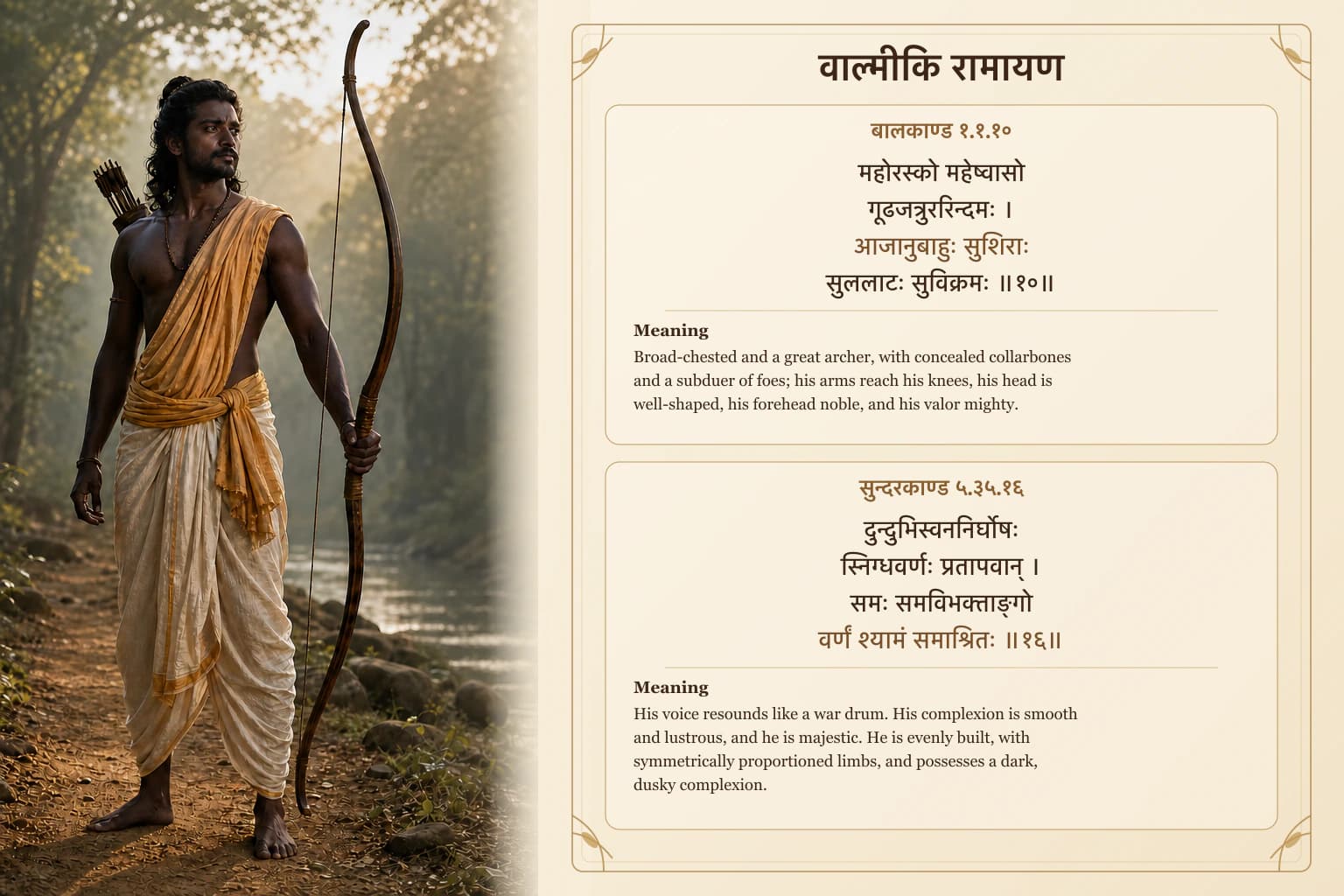
The seventh avatar of Vishnu and the hero of the Ramayana — the prince of Ayodhya whose exile, search for Sita and war with Ravana became the template for kingship, duty and devotion across South and Southeast Asia.
VaishnavaAvatar
Hanuman
हनुमानThe Devoted One
The vanara who crossed the ocean to find Sita, and the tradition's model of devotion as service. Among the most widely worshipped deities in India — invoked for courage, protection and steadiness, honoured on Tuesdays and Saturdays, and praised in the Hanuman Chalisa, very likely the most recited devotional text in the world.
Vaishnava
Lakshmi
लक्ष्मीGoddess of Fortune
The goddess of fortune, abundance and wellbeing, and the consort of Vishnu. Worshipped at Diwali in nearly every Hindu household, and understood in Sri Vaishnavism not as an attendant of the supreme but as inseparable from it.
Vaishnava
Sita
सीताThe Daughter of the Furrow
The wife of Rama and the heart of the Ramayana — found in a ploughed furrow, married at Mithila, carried off to Lanka, and in the end returned to the earth she came from. Worshipped as Lakshmi's descent and as a goddess of the earth in her own right.
VaishnavaAvatar
Jagannath
जगन्नाथLord of the Universe
The deity of Puri, worshipped in a wooden form unlike any other Hindu image, alongside his brother Balabhadra and sister Subhadra. Identified with Krishna, and the origin of the Rath Yatra — and of the English word 'juggernaut'.
VaishnavaForm / aspect
Venkateswara
वेंकटेश्वरLord of the Seven Hills
The form of Vishnu worshipped at Tirumala — among the most visited religious sites on earth, and the wealthiest temple in India. Known as Balaji, Srinivasa and Govinda, and approached with the distinctive vows of tonsure and hair offering.
VaishnavaForm / aspect
Radha
राधाThe Beloved of Krishna
Krishna's beloved, and in several traditions the personification of devotion itself. A relatively late arrival in the textual record who became, within a few centuries, inseparable from him — her name spoken first in the greeting Radhe Krishna.
Vaishnava
Dashavatara
दशावतारThe Ten Descents of Vishnu
The ten principal avatars of Vishnu — fish, tortoise, boar, man-lion, dwarf, axe-bearer, Rama, Krishna, the ninth over which the lists disagree, and Kalki who has not yet come. A set that is later, more contested and more interesting than the popular version of it suggests.
VaishnavaGroup
Vithoba
विठोबाHe Who Waits on the Brick
Krishna standing on a brick at Pandharpur with his hands on his hips, waiting — because a devotee asked him to wait while he finished serving his parents. The deity of the Varkari movement, of the Wari pilgrimage, and of some of the finest devotional poetry in any Indian language.
VaishnavaForm / aspect
Mohini
मोहिनीThe Only Female Avatar
Vishnu as a woman — the single female descent in the whole avatar scheme. She distributes the nectar so the gods get it, makes a demon burn himself, and overcomes Shiva, and every one of those is accomplished without a weapon.
VaishnavaAvatar
Mahabali
महाबलिThe King Who Is Allowed Back Once a Year
The asura king whose reign Kerala remembers as the time when everyone was equal and nobody lied — dispossessed by Vishnu in three steps, and granted one visit a year. Onam is his homecoming, and Maharashtra wishes openly for his kingdom to return.
Vaishnava
Lakshmana
लक्ष्मणThe Brother Who Followed
Rama's younger half-brother, who went into exile without being asked and killed Ravana's most dangerous son. Traditionally an incarnation of Shesha, the serpent Vishnu rests upon — and the figure who does the things Rama will not.
Vaishnava
Narasimha
नरसिंहThe Man-Lion
The fourth avatar of Vishnu — half man, half lion — who appears from a pillar at twilight to destroy Hiranyakashipu without breaking the terms of his boon. The tradition's great parable about the letter and the spirit of a promise.
VaishnavaAvatar
Varaha
वराहThe Boar
The third of Vishnu's ten avatars — the boar who dives into the cosmic ocean to raise the drowned earth on his tusks. One of the most powerfully rendered images in Indian sculpture, and an emblem of Gupta imperial art.
VaishnavaAvatar
Matsya
मत्स्यThe Fish
The first of Vishnu's ten avatars — the fish who warns Manu of the coming flood and tows his boat to safety, preserving the seeds of life and the Vedas. India's flood narrative, and the oldest of the avatar stories.
VaishnavaAvatar
Kurma
कूर्मThe Tortoise
The second of Vishnu's ten avatars — the tortoise who bears Mount Mandara on his back so the gods and asuras can churn the ocean of milk. The avatar whose entire act is to hold still and take the weight.
VaishnavaAvatar
Vamana
वामनThe Dwarf
The fifth of Vishnu's ten avatars — the dwarf brahmin who asks the generous asura king Bali for three paces of ground and takes the universe in two. The oldest of the avatar narratives, and the one in which the defeated king is the more admired figure.
VaishnavaAvatar
Parashurama
परशुरामRama with the Axe
The sixth of Vishnu's ten avatars — a brahmin who took up arms, destroyed the kshatriya order twenty-one times, and remains in the world as one of the immortals. The most troubling figure in the avatar sequence, and the tradition does not resolve him.
VaishnavaAvatar
Kalki
कल्किThe Avatar Still to Come
The tenth and final avatar of Vishnu, who has not yet appeared. Prophesied to come at the end of the Kali Yuga on a white horse with a blazing sword, to end the age and begin the next cycle.
VaishnavaAvatar
Balarama
बलरामThe Strong One
Krishna's elder brother, wielder of the plough, and in several traditions an avatar of Vishnu in his own right. Worshipped at Puri beside Jagannath, and the deity of agriculture, strength and wrestling.
Vaishnava
Dhanvantari
धन्वन्तरिPhysician of the Gods
The figure who rose from the churned ocean carrying the pot of nectar, counted an avatar of Vishnu, and honoured as the presiding deity of Ayurveda. Dhanteras is his day, and India's National Ayurveda Day is kept on it.
VaishnavaAvatar
Garuda
गरुड़King of Birds, Mount of Vishnu
The eagle who flew to heaven, fought the gods, and took the nectar to buy his mother out of slavery — and then refused to drink it. Vishnu's mount and banner, the enemy of serpents, and the national emblem of Indonesia.
Vaishnava
Tulsi
तुलसीThe Goddess Who Is a Plant
Holy basil, growing in a raised planter in the courtyard, watered every morning and given a lamp every dusk — and married to Vishnu once a year in a full wedding with guests, music and a canopy. The most-worshipped goddess in India by number of households, and the one with no temple.
Vaishnava
Hayagriva
हयग्रीवThe Horse-Necked, Who Keeps the Vedas
Vishnu with the head of a white horse, worshipped as the source of all learning — and not to be confused with the demon of the same name whom Matsya killed. The deity a Sri Vaishnava or Madhva child is introduced to before their first lesson.
VaishnavaAvatar
Subhadra
सुभद्राThe Sister in the Middle
Krishna and Balarama's sister, Arjuna's wife, Abhimanyu's mother — and the third deity on the platform at Puri, smaller than her brothers and without arms. The one member of India's most famous triad whom almost nobody can name.
Vaishnava
Shesha
शेषWhat Remains
The thousand-hooded serpent Vishnu sleeps on, who carries the worlds on one hood and finds them the size of a mustard seed. Named for what is left over when everything else has gone — and born twice as somebody's brother.
Vaishnava
Andal
आण्डालShe Who Wore the Garland First
The only woman among the twelve Alvars, and the only one worshipped as a goddess. She tried the garland on before giving it to God, wrote the thirty verses recited at every Margazhi dawn, and refused to marry anyone else.
Vaishnava
Narada
नारदThe One Who Carries the News
The sage who travels between all the worlds with a vina and no fixed address, chanting Narayana, and who sets almost every major story in the tradition in motion by telling someone something. Popular culture makes him a mischief-maker; the texts make him something more useful.
Vaishnava
Ashta Lakshmi
अष्टलक्ष्मीThe Eight Kinds of Having Enough
Lakshmi in eight forms — grain, courage, offspring, victory, knowledge, wealth, elephants and the primordial. A late set with an enormously popular hymn, and the clearest statement Hinduism makes that prosperity is not only money.
VaishnavaGroup
Sudarshana
सुदर्शनThe Discus, Personified
Vishnu's discus, given a body, a consort, a temple and a festival calendar. In the Srivaishnava temples he stands back to back with Narasimha on a single slab, and his yantra is the commonest protective diagram in South India.
VaishnavaForm / aspect
Prahlada
प्रह्लादThe Boy Who Would Not Stop Saying the Name
An asura child who would not stop repeating Vishnu's name, survived every attempt his father made to kill him, and asked for his father's forgiveness afterwards. The bonfire on the eve of Holi is his.
Vaishnava
Rukmini
रुक्मिणीThe Woman Who Wrote the Letter
Krishna's chief queen, who chose him herself, wrote to him to come and take her, and arranged the escape. At Pandharpur she is Rakhumai, standing in her own shrine a little apart from his.
VaishnavaForm / aspect
Dhruva
ध्रुवThe Fixed Point
A five-year-old turned off his father's lap went into the forest and would not stop until God came. He was given the pole star, and the whole sky turns around a child's stubbornness.
Vaishnava
Arjuna
अर्जुनNara, and the Man Who Put the Bow Down
The archer who sat down on his chariot and refused to fight, and so occasioned the Bhagavad Gita. Worshipped at Badrinath as Nara, the human half of the eternal pair Nara-Narayana.
Vaishnava
Vibhishana
विभीषणThe Brother Who Left
Ravana's youngest brother, who told him to return Sita, was thrown out of court for it, and walked over to Rama. Crowned king of Lanka — and called a traitor ever since by some.
Vaishnava